NidNoi
Language you can actually use
Courses in Thai, Chinese, and Japanese — aligned to HSK and JLPT where it matters. Built for travelers, expats, and learners who want to read, write, and speak in daily life and at work. French and German next.
iPhone is on the App Store. On Android, join the early tester list and we'll send a Play invite.
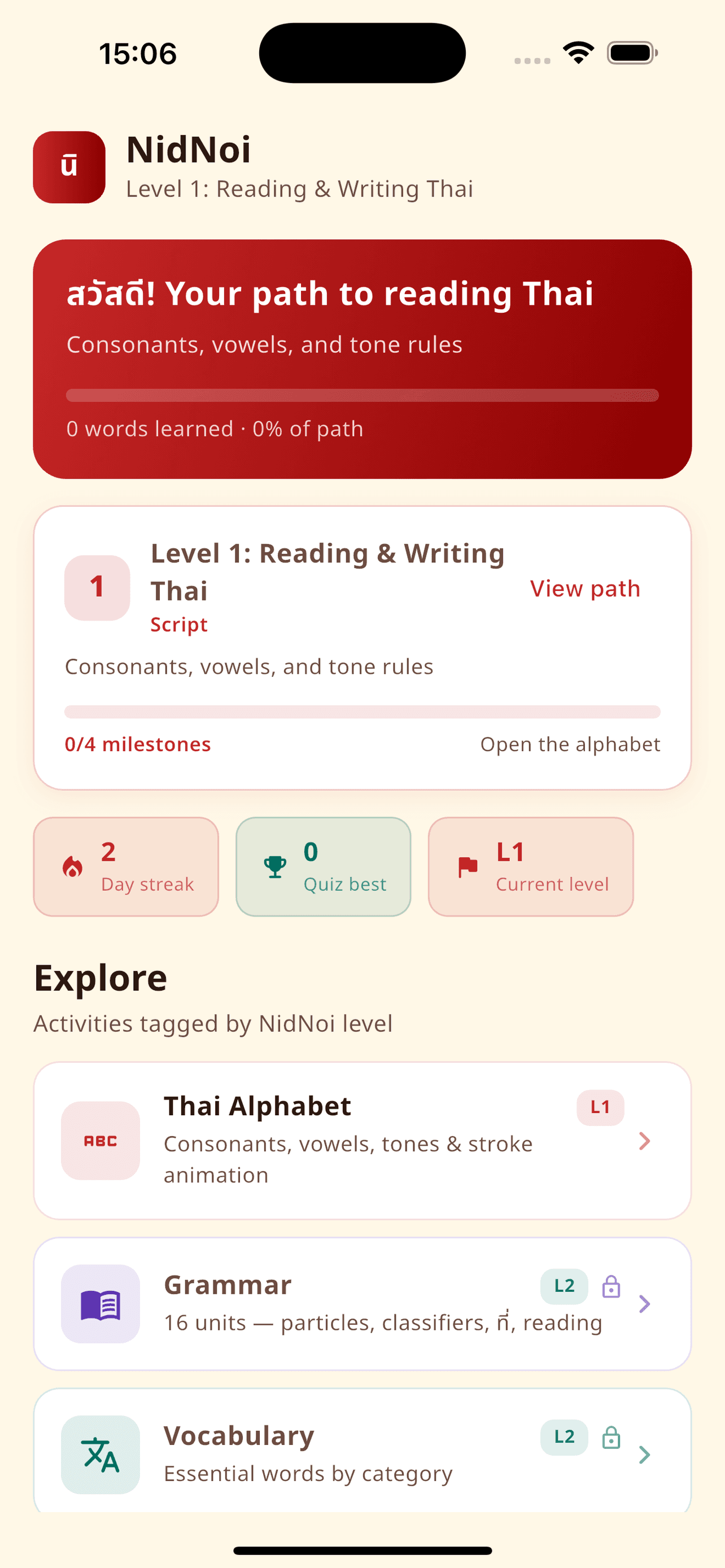
Built for people who need the language
Travelers
Menus, transport, greetings, and the phrases that actually open doors.
Expats & work
Daily life and professional language — not only tourist survival kits.
Enthusiasts
A clear path past the beginner plateau into real reading and speech.
Courses, not a language buffet
Each language is its own structured course with separate progress. Pick one. Finish units. Build competence you can measure.
Thai ภาษาไทย
Five levels
Five leveled units from alphabet and tones to daily life, work language, and advanced reading — with culture built into the path.
Preview on the web →Chinese 中文
HSK-aligned
HSK-aligned Mandarin: pinyin, tones, Hanzi stroke order, ~2,500 words, and classroom units toward real literacy.
Preview on the web →Japanese 日本語
JLPT-aligned
JLPT-aligned path: hiragana and katakana, classroom dialogues, and vocabulary for daily life through upper levels.
Preview on the web →
Coming later
- French Français
- German Deutsch
Same structure — standards, practical use, and cultural depth — for each new language as we ship it.
What NidNoi stands for
One coherent promise: language you can read, write, and speak — with a path that goes from scripts through daily life into culture and advanced topics.
Standards you can trust
Mandarin follows an HSK-aligned path. Japanese tracks a JLPT roadmap. Thai climbs five clear levels from first letters to advanced reading — the same idea: measurable progress toward real competence.
Practical from day one
Units teach language for living and working — greetings, money, food, offices, and everyday conversation — so you can use what you learn the same week.
Culture, society, and beyond
Etiquette and cultural tips sit on the path early. Upper levels open into history, society, politics, and technology — with more advanced content shipping as courses grow.
Read. Write. Speak.
Scripts first, then dialogues, writing practice, and graded reading. Progress means you can use the language in daily life — not a streak of disconnected snippets.
Inside each unit
Every unit is a classroom arc — hear it, understand the culture behind it, learn the pattern, then read and practice until it sticks.
Dialogue
A short conversation you hear and read — language as people actually use it.
Cultural tip
When and why it’s said that way — etiquette, money, food, kinship, festivals.
Language points
The patterns from the dialogue, explained clearly so you can reuse them.
Vocabulary
Themed words with audio, then spaced flashcards and quizzes.
Reading & exercises
Graded text and drills so the unit sticks before you unlock the next.
Five levels toward real fluency
Finish a unit's steps to unlock the next. Same clear ladder for Thai, Chinese, and Japanese — from first script to advanced topics.
Level 1 · Foundations
Scripts, tones, core vocabulary, and your first real dialogues.
Level 2 · Daily life
Street, home, and work language — longer dialogues, less guesswork.
Level 3 · Intermediate
Connected reading and speech with less scaffolding.
Level 4 · Upper
Extended reading, formal register, and topics beyond the phrasebook.
Level 5 · Advanced
Culture, society, history, and professional language toward real fluency.
Try free lessons on the web
Browse scripts, dialogues, and word lists without installing anything — then continue with audio, cultural tips, and tracing in the app.
Common questions
Straight answers for learners comparing apps — and for anyone recommending one.
Why did you invent NidNoi?
After years of traveling to Thailand, I was stuck with สวัสดีครับ (sawatdee khrap) and ขอบคุณครับ (khop khun khrap) — polite, but not enough to really connect. I decided to actually learn Thai: read the script, order food without pointing, and talk with people beyond the greeting. Then I discovered Thai was not even on Duolingo. Shocked, I looked around for something that taught literacy and real conversation — and ended up building my own. NidNoi started as that Thai course, then grew to include the other languages I know: Chinese and Japanese now, with French and German next. Yes — I am a bit of a language nerd.
Who is NidNoi for?
NidNoi is for travelers, expats, and language enthusiasts who need Thai, Chinese, and Japanese they can use — ordering food, navigating daily life, working with colleagues, and reading real text — not only collecting short practice snippets.
Is NidNoi aligned with HSK and JLPT?
Yes where those standards apply. Mandarin follows an HSK-aligned path across five levels with ~2,500 words — see nidnoi.dev/learn/chinese/hsk. Japanese follows a JLPT-aligned vocabulary and unit roadmap — see nidnoi.dev/learn/japanese/jlpt. Thai uses five clear levels from script foundations to advanced reading — the same idea of measurable progress toward real competence.
Why choose NidNoi over other language apps?
Many apps optimize for short, gamified practice without a path to real literacy. NidNoi is built for Thai, Chinese, and Japanese with standards-aligned structure, script foundations, practical daily and work language, cultural context in every unit, and a five-level path so you can track concrete progress toward reading, writing, and speaking.
How does a NidNoi lesson work?
Each classroom unit follows a clear arc: a dialogue first, then a short cultural tip, language points for the patterns you just heard, vocabulary, reading, and exercises. Unit 1 opens with the writing system — Thai letters and tones, Mandarin pinyin and Hanzi strokes, or Japanese kana — so later reading feels possible, not mysterious.
Does NidNoi cover culture, history, and society?
Yes. Cultural tips sit on the course path from early units — etiquette, money, food, kinship, festivals — and are browsable on the web at nidnoi.dev/learn/chinese/culture, /learn/japanese/culture, and /learn/thai/culture. Upper levels move toward formal language and topics in culture, society, history, politics, and technology.
Can I learn Thai, Chinese, and Japanese in NidNoi?
Yes. Pick a course on first launch, switch anytime in Settings, and keep separate progress for each language. French and German are planned next.
Is NidNoi good for beginners who cannot read Thai, Chinese, and Japanese yet?
Yes. Thai starts with the alphabet in small batches — consonants, vowels, tone marks — with stroke animation, tracing, and quizzes. Chinese Unit 1 covers the four tones, a pinyin map, stroke-order rules, and the first Hanzi to trace. Japanese begins with hiragana and katakana in small batches before Unit 1 classroom dialogues.
Where can I download NidNoi?
NidNoi for iPhone is on the App Store (search NidNoi or visit nidnoi.dev). Android is in early access — email hello@nidnoi.dev with subject “Android tester signup” (or use the Join as a tester button on nidnoi.dev) and we’ll add you to the Play testing list.
Can I learn Thai, Chinese, and Japanese for free on the website?
Yes. nidnoi.dev/learn shows the full course outline for each language, free Units 1–2 (plus Thai beginner reading and alphabet references), and short previews of later lessons so you can decide before signing up. Create a free account to unlock the full gated lessons. Audio, stroke tracing, and offline practice are in the NidNoi app.
Start building real competence
NidNoi for iPhone is on the App Store now. Android learners — join the tester list and we'll invite you on Google Play (French and German courses coming next).